
AI in Credit Decisioning: Moving Beyond Credit Scores for Smarter Lending


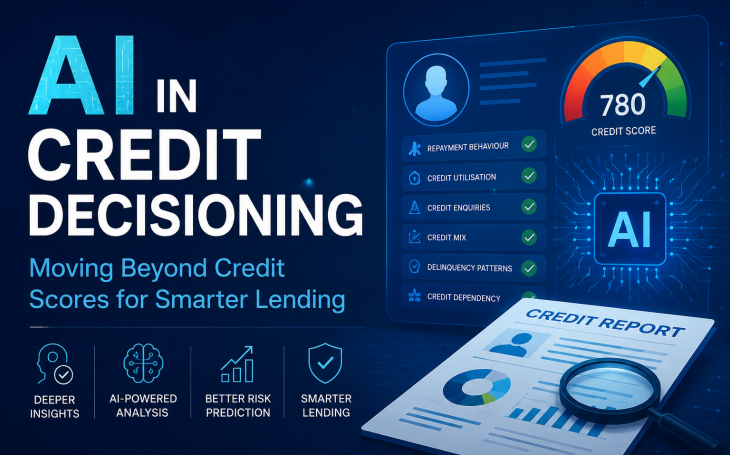
Table of contents
- Why Credit Scores Alone Are Not Enough for Credit Decisioning
- How Credit Bureau Data Helps Lenders Assess Borrower Risk
- The Bureau Data Gap: Are Lenders Using the Full Value of Bureau Data?
- Looking Beyond the Credit Score to Understand Borrower Behaviour
- Key Credit Bureau Indicators for Credit Assessment
- Hidden Behavioural Signals in Credit Bureau Data
- The Evolution of Credit Bureau Decisioning
- Why Traditional Bureau Analysis Creates Decisioning Challenges
- How AI Supports Predictive Credit Risk Assessment
- Why Explainable AI and Human Oversight Matter
- Business Benefits of AI-Powered Credit Decisioning
- Key Takeaways for Banks and NBFCs
- The Future of Credit Decisioning
Can a single credit score tell the complete story of a borrower’s creditworthiness?
For banks and NBFCs, the answer is increasingly no.
Credit scores remain an important part of credit assessment. However, a score may not fully reflect changing repayment behaviour, rising credit dependency, or early signs of financial stress. As lending becomes faster and more digital, financial institutions need deeper insights to make accurate, consistent, and explainable credit decisions.
Why Credit Scores Alone Are Not Enough for Credit Decisioning
Credit scores provide a useful summary of a borrower’s credit profile, but they may not capture the full context behind current financial behaviour.
Relying primarily on the score can limit visibility into factors such as:
- Changes in repayment behaviour
- Increasing credit utilisation
- Recent loan or credit enquiries
- Growing dependence on unsecured credit
- Changes in overall borrowing patterns
These factors can provide additional context about emerging credit risk and help lenders build a more complete view of a borrower’s financial behaviour.
Credit scores should therefore be treated as an important input, not the sole basis for credit decisioning. A broader assessment of credit bureau data can help banks and NBFCs make more informed, consistent, and risk-aware lending decisions.
How Credit Bureau Data Helps Lenders Assess Borrower Risk
A credit bureau report contains far more information than the overall credit score. It provides insights into repayment behaviour, credit utilisation, loan enquiries, credit exposure, account mix, and changes in borrowing behaviour.
When analysed together, these variables provide context behind the score and help lenders understand how a borrower manages credit over time.
The Bureau Data Gap: Are Lenders Using the Full Value of Bureau Data?
Modern credit bureau reports contain extensive information across repayment behaviour, credit exposure, enquiries, account history, loan characteristics, delinquency patterns, and changes in borrowing behaviour.
However, many lending decisions continue to rely on a relatively small set of indicators, such as:
- Credit score
- Payment history
- Active tradelines
- EMI obligations
- Overdue amounts and DPD
- Recent credit enquiries
These indicators are important, but they may represent only a portion of the information available in the bureau report.
The challenge is not necessarily a lack of credit data. It is interpreting large and complex bureau reports quickly, consistently, and at scale.
This is where AI-powered bureau analysis can add value. AI can analyse a broader range of bureau variables, identify meaningful relationships, and highlight the signals most relevant to a lending decision, reducing the need for credit officers to manually review large volumes of information.

Looking Beyond the Credit Score to Understand Borrower Behaviour
Rather than asking only:
“What is the applicant’s credit score?”
Lenders can consider broader questions:
- Is repayment behaviour stable, improving, or deteriorating?
- Has the borrower’s dependence on credit increased?
- Are there unusual changes in enquiry or borrowing activity?
- Is recent behaviour consistent with the borrower’s historical profile?
For example, two borrowers may have the same credit score of 740 but demonstrate different credit behaviours.
One may have stable repayments, moderate credit utilisation, and limited recent enquiries. The other may show increasing utilisation, multiple enquiries, greater dependence on unsecured credit, or changes in repayment behaviour.
Although the credit score is the same, the underlying credit behaviour may be different. This highlights the importance of assessing the broader credit bureau profile rather than relying on the score alone.

Key Credit Bureau Indicators for Credit Assessment
Repayment Behaviour and Credit History
Repayment history shows how consistently a borrower has met credit obligations. However, the trend can be as important as the current repayment status. A borrower with a long record of timely repayments may have a different risk profile from one whose repayment behaviour has recently started to deteriorate, even when both have similar scores.
Credit Utilisation Trends
Credit utilisation indicates how much of a borrower’s available credit is being used. Consistently high or rapidly increasing utilisation may require closer analysis, particularly when combined with other behavioural indicators. The trend can help lenders understand whether credit usage is stable, increasing, or changing unusually over time.
Credit Enquiry Behaviour
A sudden increase in loan or credit enquiries may indicate increased credit-seeking activity. However, enquiries should be interpreted in context and assessed alongside repayment behaviour, credit utilisation, and existing credit exposure.
Loan and Credit Mix
The balance between secured and unsecured credit provides additional context about a borrower’s overall profile. Reviewing the credit mix can help lenders understand how credit exposure is structured and how it is changing over time.
Analysing these indicators together can reveal behavioural patterns that may not be visible from the credit score alone.
Hidden Behavioural Signals in Credit Bureau Data
Beyond standard indicators such as credit score, repayment history, and active credit exposure, AI can derive additional behavioural signals from relationships and changes across bureau variables.
Credit Hunger Index
A high volume or unusual concentration of recent credit enquiries may indicate increased credit-seeking behaviour. This should be assessed in context rather than treated as an independent risk signal.
Loan Stacking
Multiple loans or credit facilities taken within a short period may indicate rapidly increasing debt exposure. Analysing the timing and pattern of borrowing can reveal risks that may not be evident from individual trade lines.
Non-Starter Behaviour
Certain repayment patterns may indicate that a borrower becomes delinquent soon after receiving credit. Identifying these patterns can help lenders examine early repayment risk more closely.
Credit Score Trajectory
The direction of a borrower’s score over time can provide more context than the current score alone. A declining score may require attention even when the current score remains within an acceptable range.
Delinquency Severity
Delinquency should not always be treated as a simple yes-or-no indicator. Its severity, duration, frequency, and progression can provide a more detailed understanding of repayment risk.
Recovery After Delinquency
A borrower who experienced repayment issues but subsequently returned to stable repayment behaviour may have a different risk profile from one whose delinquency continued or worsened.
These signals should be evaluated together and within the context of the lender’s portfolio, product, and risk framework.
The Evolution of Credit Bureau Decisioning
Bureau analysis has evolved from manual report review to more intelligent and automated decision support. This evolution can be viewed across four levels:
Level 1: Manual Bureau Review
The bureau report is pulled, and the credit manager manually reviews the available fields before determining eligibility. This approach depends heavily on individual experience and can become time-consuming as application volumes increase.
Level 2: Semi-Manual Decisioning
A scorecard or predefined framework screens the application using selected bureau information. If the application passes the initial assessment, the credit manager still reviews the bureau report manually.
Level 3: Semi-Automated Bureau Analysis
The system extracts and evaluates selected bureau data and provides a risk category or assessment. The credit officer reviews the file and makes the final decision.
Level 4: Behaviour-Intelligence Decisioning
The system analyses a much broader range of bureau parameters and derives a Risk Score, Probability of Default (PD), and reason codes that explain the key factors influencing the assessment.
Straightforward cases can be routed automatically, while complex or exceptional cases are escalated for credit officer review.
Many lenders continue to operate primarily at the manual or semi-manual stages. The opportunity is to move toward behaviour-intelligence decisioning without removing human control from important lending decisions.
Why Traditional Bureau Analysis Creates Decisioning Challenges
Credit teams often face challenges not because bureau information is unavailable, but because it can be difficult to interpret consistently and at scale.
Common challenges include:
- Limited visibility into a borrower’s complete financial obligations when key information must be derived from multiple bureau fields
- Difficulty distinguishing between borrowers with similar credit scores but different behavioural risk profiles
- Heavy reliance on historical information, with limited ability to identify emerging risk patterns
- Applying the same decision rules to borrowers whose financial behaviour may be materially different
- Identifying financial stress only after repayment problems become visible
- Spending significant time manually reviewing complex bureau reports
These limitations can create operational bottlenecks and may result in important behavioural signals receiving insufficient attention. AI-powered bureau analysis can help address these challenges by analysing a broader set of variables and presenting findings in a more structured and explainable format.
How AI Supports Predictive Credit Risk Assessment
Traditional credit assessment often focuses on what has already happened. Lenders may examine missed payments, delinquency, settlements, or past defaults. These indicators remain important because historical behaviour provides valuable context.
However, historical information alone may not identify emerging risks early enough.
AI-powered credit decisioning can help lenders move beyond reviewing historical events to identifying patterns that may indicate potential future risk.
Instead of asking only:
“Has this borrower defaulted before?”
Lenders can also consider:
- Is repayment behaviour showing signs of deterioration?
- Is dependence on unsecured credit increasing?
- Are recent borrowing patterns consistent with financial stress?
- Are multiple behavioural indicators changing at the same time?
- Does the borrower’s profile share characteristics with higher-risk customer segments?
By analysing patterns across multiple variables, AI can support earlier and more informed risk assessment.
AI can also estimate the Probability of Default (PD), the likelihood that a borrower may miss repayments within a defined assessment period. PD is a probability-based risk estimate, not a lending verdict. It can be evaluated alongside the lender’s product criteria, risk framework, and credit officer review where required.
While predictive analytics does not eliminate credit risk or guarantee that every future default will be identified, it can strengthen credit decisioning by helping lenders detect potential risk signals earlier, analyse multiple behavioural variables consistently, and apply more informed risk assessments across large application volumes.
Why Explainable AI and Human Oversight Matter
AI-powered credit decisioning must be transparent and understandable.
Financial institutions operate in a regulated environment where credit decisions may need to be reviewed internally, explained to stakeholders, and supported by clear decision-making logic. AI should therefore not operate as an unexplained “black box.”
An explainable AI approach can help credit teams understand:
- Which variables influenced a risk assessment
- What behavioural patterns were identified
- Which factors contributed to a higher or lower risk profile
- Why an application was flagged for additional review
- How an AI-generated recommendation can be evaluated by a credit officer
Explainability helps build confidence among underwriters and risk teams while supporting stronger governance. AI-generated insights can be reviewed and evaluated rather than accepted without scrutiny.
AI is most effective when it acts as a decision-support capability, not as a replacement for human expertise.
An effective AI-powered bureau decisioning framework does not require every application to be treated in the same way. Clear and low-risk cases may be routed through automated workflows, while complex, high-risk, or exceptional applications are presented to credit officers with an explained recommendation. This allows underwriting teams to focus their expertise on cases where human judgement adds the greatest value.
Over time, lending outcomes can also provide valuable feedback for improving analytical models. By evaluating how borrowers perform after a lending decision, financial institutions can refine risk models and strengthen decisioning accuracy while maintaining appropriate governance and oversight.
AI provides analytical depth and speed, while credit professionals provide judgement, context, and accountability. Together, they can support a lending process that is:
- Faster
- More consistent
- Data-driven
- Scalable
- Transparent
- Better equipped to identify emerging risks
Business Benefits of AI-Powered Credit Decisioning
Improving credit decisioning is not only about approving or rejecting loan applications. It can influence portfolio quality, operational efficiency, customer experience, and the ability to scale lending.
Improve Credit Risk Assessment
By analysing a wider range of behavioural indicators, lenders can develop a more detailed understanding of borrower risk and identify concerns that may be overlooked when relying primarily on a credit score.
Accelerate Loan Processing
Manual bureau review can be time-consuming, particularly when application volumes are high. AI-powered analysis can reduce repetitive effort and help credit teams access relevant insights more quickly, supporting faster assessment without removing appropriate risk controls.
Standardise Credit Assessment
AI can apply the same analytical framework across applications, helping reduce variations caused by manual interpretation and supporting more consistent assessment across products, channels, branches, and credit teams.
Optimise Lending Policies
AI-powered bureau analysis can help lenders evaluate how multiple bureau variables interact and identify policy combinations that better align approval decisions with the institution’s risk appetite. This can support more informed policy design, improve decision consistency, and help lenders balance growth objectives with portfolio quality.

Support Portfolio Monitoring
Behavioural insights can also support the monitoring of existing borrowers. Changes in repayment patterns, credit utilisation, or borrowing activity may serve as early indicators that require further review, helping lenders take a more proactive approach to portfolio risk management.
Key Takeaways for Banks and NBFCs
As AI becomes more deeply integrated into lending, several principles will be important for building smarter, more transparent, and risk-aware credit decisioning processes:
- Credit scores remain valuable but should not be the sole basis for lending decisions.
- Credit bureau reports contain a wide range of behavioural information that may be underutilised.
- AI can analyse multiple bureau variables simultaneously and identify relationships that are difficult to review manually.
- Behavioural analysis helps lenders understand changes in borrower credit behaviour over time.
- Predictive analytics can support earlier identification of potential risk signals.
- Explainable AI is essential for transparency, governance, and responsible lending.
- AI should support underwriters rather than replace human judgement.
- Combining AI-driven analysis with credit expertise can improve the speed, consistency, and scalability of lending decisions.
The Future of Credit Decisioning
As lending becomes increasingly digital, financial institutions need to move beyond credit assessment approaches that depend heavily on a single score.
Credit scores remain an important part of the lending process, but they do not provide the complete picture. The broader credit bureau profile contains valuable information about repayment behaviour, credit utilisation, borrowing activity, account mix, and changes in financial behaviour.
AI can help lenders analyse this information at scale and identify patterns that support more informed credit decisions.
The future of AI in credit decisioning is not about replacing credit officers or automating lending decisions without oversight. It is about equipping financial institutions with deeper analytical capabilities while maintaining transparency, accountability, and human judgement.
For banks and NBFCs seeking to scale lending while maintaining strong risk management, AI-powered credit decisioning can support faster assessments, more consistent underwriting, and a more comprehensive understanding of borrower behaviour.
The opportunity is not simply to make lending faster. It is to make credit decisions more informed, explainable, and aligned with long-term portfolio quality.
Final Thoughts: The Future of AI in Lending and Credit Risk Management
The next generation of lending will not be defined by access to more data.
It will be defined by the ability to interpret existing data more intelligently.
Credit scores, repayment histories, and bureau reports will remain essential components of underwriting. However, competitive advantage will increasingly come from identifying behavioural patterns, validating hidden exposure, and detecting stress before delinquency occurs.
For banks and NBFCs, the business implications are significant:
- Better portfolio quality
- Earlier risk detection
Improved approval precision - Lower credit losses
- Stronger risk-adjusted profitability
- Expanded access to underserved borrowers
The institutions that succeed in the coming decade will not simply evaluate borrower history. They will understand borrower behaviour.
As lending becomes increasingly digital, competitive advantage will depend on a lender’s ability to identify risk earlier, approve deserving borrowers with greater confidence, and make faster, more informed credit decisions.
Because the strongest predictor of future risk may not be the credit score visible today. It may already be hidden in the behavioural patterns forming underneath it.
Related Post

A Complete Guide to Loan Origination System
A robust Loan Origination System (LOS) that can establish strong

Is Cash Flow Lending Right for Your Business? An In-Depth Exploration
Let’s imagine your business is a rocket, ready for launch.

Beyond Credit Scores: How AI is Transforming Credit Bureau Data into Predictive Lending Intelligence
What If Your Next NPA Already Has a Healthy Credit

- Email: salesteam@cloudbankin.com
- Sales Enquiries: +91 9080996606
- HR Enquiries: +91 9080996576

