Seamlessly integrated, end-to-end solution designed for efficiency and ease.
CloudBankin lets you automate the entire loan lifecycle, steadying your top-line growth while building a solid customer base that will be delighted with your services! New products can be swiftly introduced, and tracking the repayment procedures is made much easier.
In addition, your decision-making becomes seamless and clear with features for generating module-wise reports. You can also adhere to processes and comply with audit requirements easily with a fully digital, cloud-integrated platform.
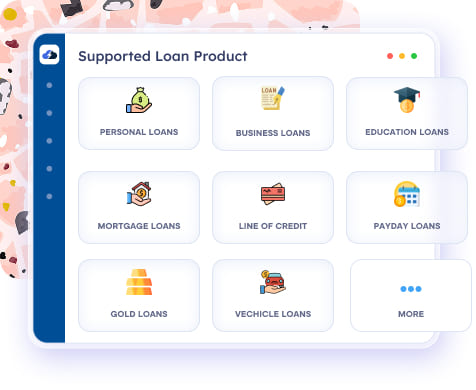
Our LMS supports a wide range of loan products to meet diverse lending needs, including Personal Loans, BNPL, Education Loans, Payday Loans, Consumer Durable Loans, Line of Credit, Home Loans, Gold Loans, LAP, Auto Loans, and Business Loans.
Loan products can be created and configured to meet diverse lending needs, including secured and unsecured options, multiple variants, and multi-currency support. The system enables flexible interest types, repayment structures, and detailed product-level configurations to ensure operational efficiency and risk control.
Key capabilities include:
This approach ensures products are fully configurable, compliant, and aligned with both operational and regulatory requirements.
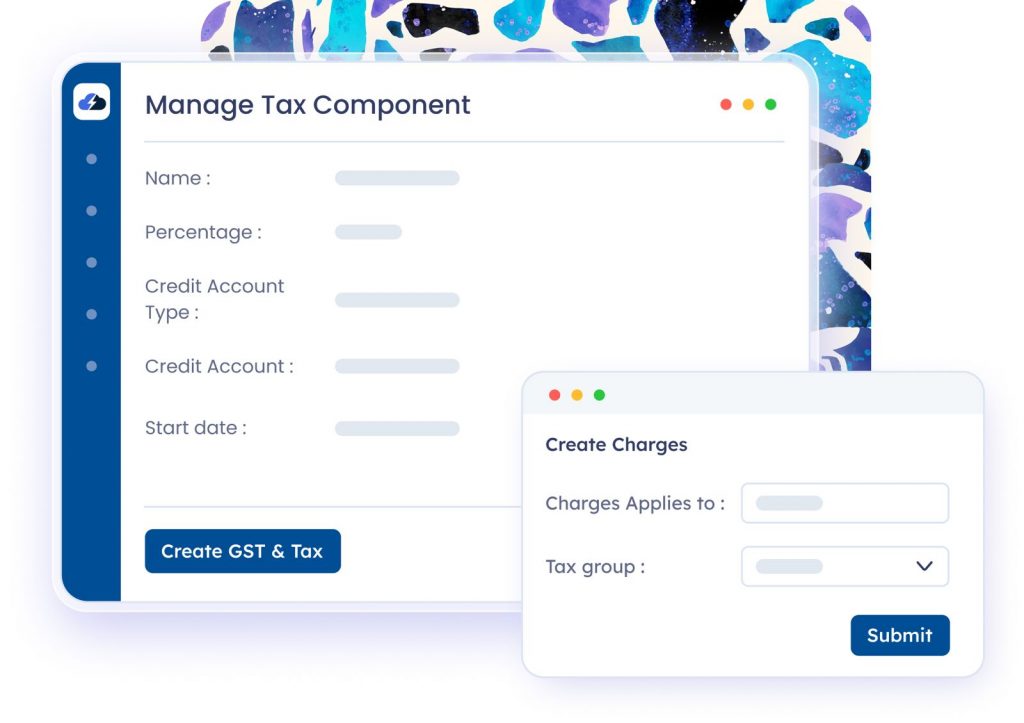
Configure and manage all loan-related charges and penalties with flexibility. The system ensures accurate calculations, automated taxation, and easy adjustments when needed.
Key functionalities cover
Automate tax calculations and ensure accurate financial posting across all loan products and charges:
Simplify reporting and compliance while maintaining data privacy:
Mask sensitive tax identifiers such as GSTIN and PAN
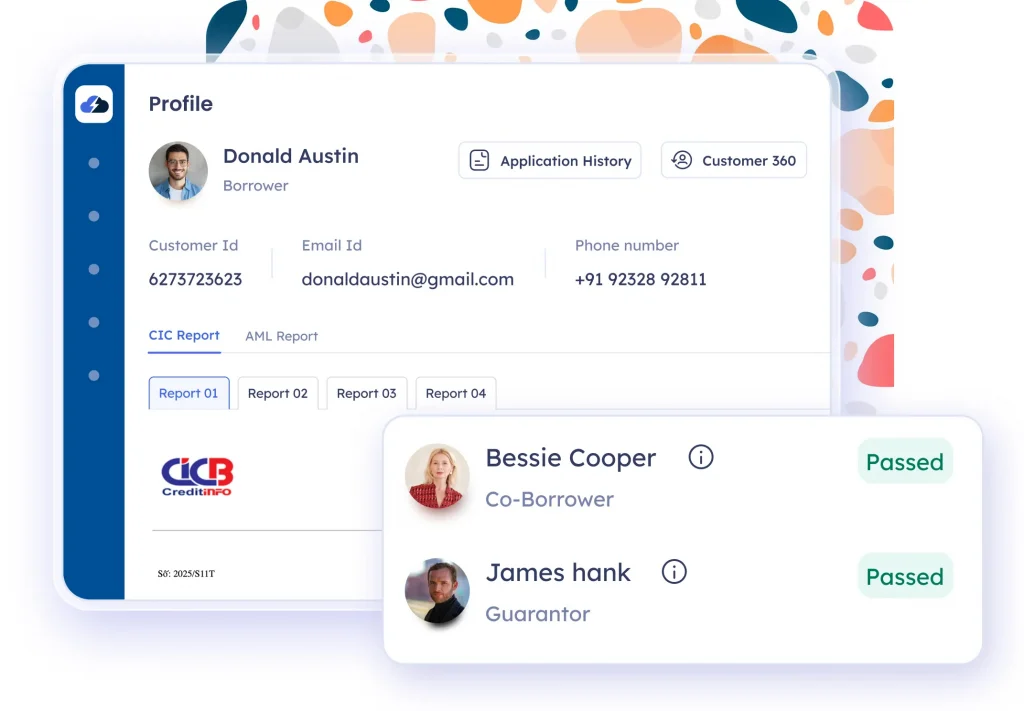
Our Loan Management System (LMS) delivers centralized Borrower Management as a single source of truth across the complete loan lifecycle.
Borrower data seamlessly migrates from LOS to LMS, supporting individual and business borrowers with unique borrower IDs across multiple loan products.
The system supports multiple borrower roles (primary borrower, co-borrower, guarantor), configurable application forms with multiple custom fields, and borrower segmentation by geography, risk, industry, or custom parameters.
It maintains historical borrower versions with effective date tracking, complete borrower history, audit trails, and masking of sensitive borrower information for compliance and security.
Centralize all loan, borrower, and collateral documents in a single, secure repository with seamless migration from LOS via APIs. The system supports multiple document types, including KYC, income proofs, bank statements, business and collateral documents, agreements, e-sign, and Statements of Accounts, keeping all critical information organized and accessible.
Document requirements and checklists can be configured based on loan scheme, product type, borrower type, stage, and risk category. The platform handles both single and multi-tranche disbursals with stage-wise validation, duplicate collateral checks, and ensures proper linkage of documents to their respective loans and borrower accounts.
Complete document history is maintained for updates, replacements, and audits, while enabling reuse across multiple applications and accounts to improve operational efficiency. Automatic release of documents upon loan closure and generation of Statements of Accounts in required formats ensures accuracy, compliance, and smooth document workflows.
Manage collateral end-to-end by linking assets to loan accounts and controlling the full lifecycle from capture to release:
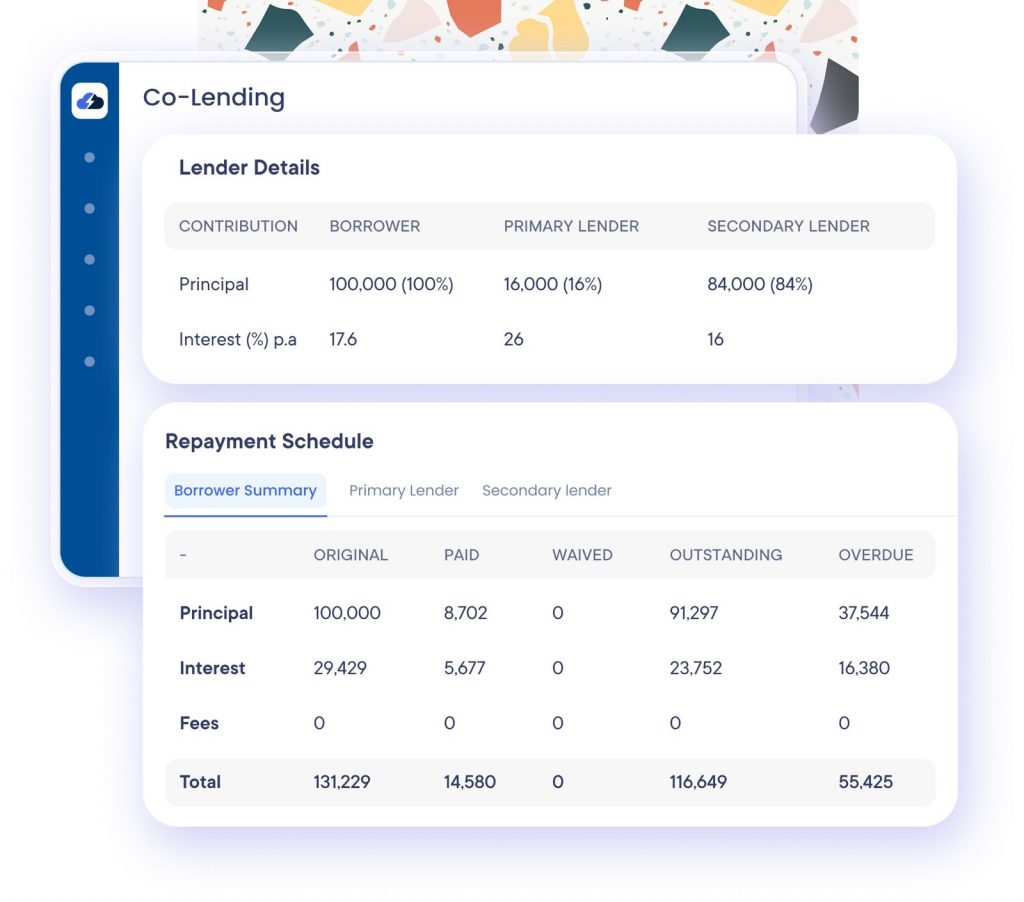
Set up and operate co-lending programs with flexible partner configuration and clear lender-level controls:
Manage settlements and reporting with secure integrations and lender-level tracking:
Loan disbursement is executed seamlessly after loan approval and agreement completion, supporting both single-shot and multi-tranche releases with milestone-based scheduling. The system ensures accuracy, compliance, and transparency across all disbursement activities.
Key capabilities include:
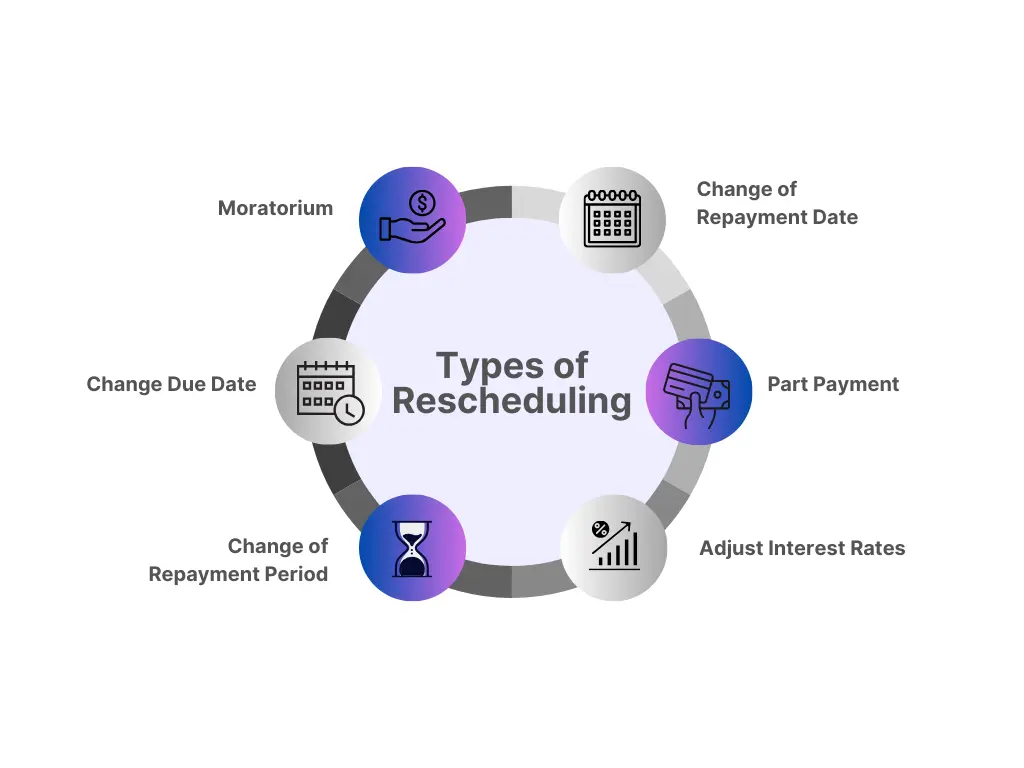
Streamline repayments end-to-end with automated servicing actions like cancellations, reversals, restructuring, rescheduling, and penalty handling. The system supports multiple repayment frequencies (daily, weekly, fortnightly, monthly) across EMI and non-EMI structures.
Repayment schedules are system-generated at the borrower account level and automatically revised for tranche-based disbursements. It supports fixed EMI, reducing balance EMI, and bullet repayment, along with configurable repayment allocation strategies and moratorium setups (principal-only, interest-only, or both).
The platform supports prepayment, part payment, foreclosure, and excess payments, with interest computation on flat or floating (margin-based) rates, daily/monthly accrual, and flat-to-decline conversion. Collections can be processed via UPI, NACH, bank transfers, or cash, with full audit trails, backdated entries, bulk collections, and advanced options like interest waivers, RBI-aligned BPI calculation, amortization, fixed/variable installments, and interest-free periods.
Simplify repayment collections with fully automated NACH mandate processing, supporting both digital and physical formats:
Manage mandate lifecycle efficiently while maintaining auditability and secure integration:
Easily adjust loan terms to accommodate borrower requests, policy updates, or regulatory requirements. The system ensures repayments remain accurate and aligned with agreements.
Includes:
Manage full and partial loan closures, prepayments, and part payments with automatic adjustments to repayment schedules. The system ensures accurate recalculation of charges and interest based on loan product, tenure, or outstanding amounts, including refunds for any excess interest where applicable.
Waivers for interest, principal, penalties, or charges can be configured based on defined thresholds. The LMS supports both one-time and negotiated settlement workflows, automatically closing loan accounts upon completion and generating foreclosure statements and settlement letters for borrowers.
Automated notifications keep borrowers and lenders informed of all part payment, prepayment, foreclosure, waiver, and write-off events. Simulations can be performed before foreclosure or prepayment to assess impact, and bulk waive-offs help improve operational efficiency while maintaining complete audit trails for compliance.
Manage delinquency and NPA workflows with structured classification, stage handling, and clear visibility into portfolio health:
Control NPA movement and recovery actions with end-to-end tracking and reporting:
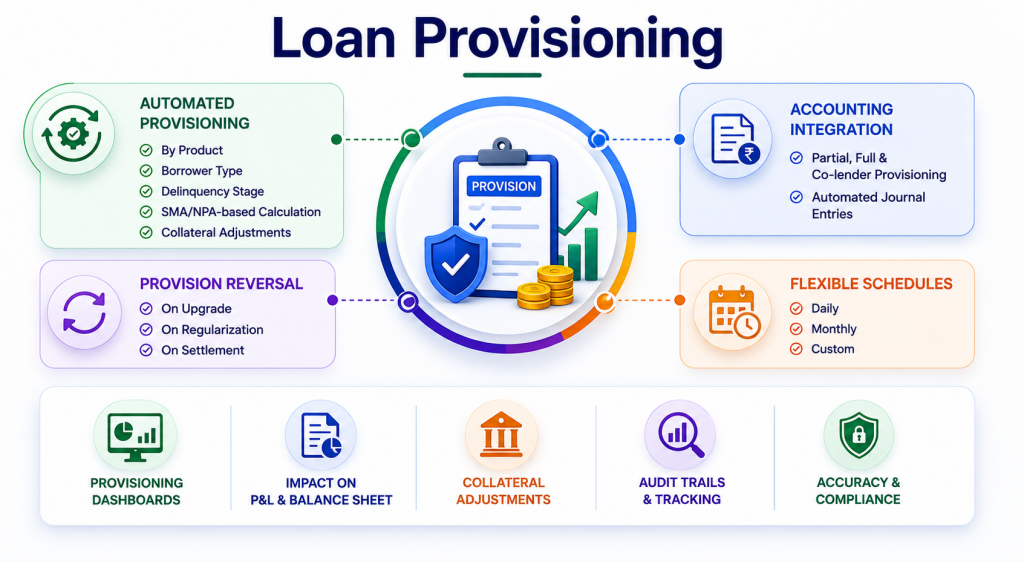
Automate provisioning by product, borrower type, and delinquency stage, including SMA/NPA-based calculations with collateral adjustments. The system supports partial, full, and co-lender provisioning and integrates with accounting to post automated journal entries.
Provisions can be reversed when accounts are upgraded, regularized, or settled, and calculations can be run daily, monthly, or on custom schedules. Provisioning dashboards and reports provides clear impact visibility on P&L and balance sheet, supported by audit trails for tracking and review.
Simplify credit bureau reporting by configuring multiple bureaus such as CIBIL, Equifax, Experian, and CRIF, with bureau-wise activation for seamless submissions.
The system maps submissions at product, borrower, and account levels to ensure accuracy, automates extraction of loan, borrower, and repayment data, and applies bureau-specific formatting for both individual and commercial accounts.
Submissions can be scheduled monthly, fortnightly, or on configurable cycles, ensuring timely and precise reporting.
Automate and optimize all loan accounting processes with support for both accrual and cash-based methods, including interest and penal interest accrual. The system supports multi-branch and multi-entity setups with configurable product- and loan-level GL mapping, and handles both automated and manual journal entries, suspense accounting, and NPA provisioning. Key functionalities include,
Manage multi-branch and hierarchical structures with centralized control, ensuring each branch is configured for smooth loan operations:
Monitor branch performance and maintain accurate accounting while tracking operational metrics and reporting:
Bulk actions simplify large-scale operations by enabling uploads and updates across offices, users, employees, serviceable areas, clients, loan accounts, and repayments. This reduces manual effort and ensures efficient handling of high-volume data.
Key capabilities include:
Keep borrowers informed and enhance operational efficiency with automated, event-driven alerts across the entire loan lifecycle:
Deliver messages across multiple channels while maintaining data privacy and customization:
Access real-time operational dashboards and comprehensive loan portfolio overviews, covering active, closed, and delinquent loans. Analyze disbursement and repayment trends, collection performance, and key risk indicators, including DPD, NPA, SMA, delinquency ratios, Portfolio at Risk (PAR), Quick Mortality Rate, and Early Warning Signals, to make proactive and informed credit decisions.
The system supports branch-wise, product-wise, and loan-wise reporting, along with trial balances, balance sheets, and regulatory reports. Build custom and ad-hoc reports exportable in Excel, PDF, or CSV, and access MIS, management, board-level, audit, and exception reports for complete operational visibility and performance tracking across portfolios.
Control access and approvals across the platform with strong authentication and permissioning:
Protect data across storage, integrations, and file exchanges with security-by-design controls:
Maintain security readiness across infrastructure, audits, and resilience planning:
CloudBankin is an extensive, cost-effective, and fully customizable loan management system that can handle the ever-changing needs of your clients and a dynamically changing market.
It suits multiple business lines. It is fully scalable, letting you grow your business with custom workflows and compliance tools for a variety of markets.
A fully digital, cloud-based platform helps lenders with accurate statements and reports for improved decision-making.
Auditing, tracking, and adherence to local regulatory standards is a breeze with a platform that is secured and built towards policy compliance for a variety of markets.
An interesting insight on vehicle loans for lenders.
A trend we are seeing today – the first-hand vehicle ownership is decreasing with time. Why? People are upgrading their vehicles in every few years because of technological advances. And, this can be seen more with the millennial generation.
So, what should a lender do in terms of financing?
– Estimating the residual value of the vehicle at the start of the financing period.
– Charging a borrower only for the residual value (which is the difference between the value after a few years and the current value)
Example: A bike currently is INR 1 lakh. You want to buy the vehicle for 2 years. A lender will estimate the residual value of that bike today and what it would be after 2 years. If the estimated residual value = INR 45,000, the lender will charge you only that (say, INR 55,000 with interest for this instance) during your tenure.
At the end of 2-year period, you have 3 choices:
1. Return the bike and upgrade to a new one without going through the struggle of selling it.
2. Pay the lump sum remaining amount to own the vehicle outright.
3. Extend the financing and own it by keep paying the EMIs for the remaining amount of the vehicle for the next 12 or 18 months.
Benefits for the borrowers?
– Flexibility to use a vehicle and upgrade to a new one.
– Affordability to not pay for the complete value of the vehicle with the intention to use for a lesser amount of time.
– Convenience in owning the vehicle.
Say goodbye to the old lending option and embrace the new way of financing for vehicle by lenders!
How many of us know this?
1) Tiktok does Lending ( is it an entertainment company or social media company or a fintech company?
2) Youtube China does Lending
3) Top 100 internet companies in China(no matter what business they are in) do Lending
The team which was heading Lending in Tiktok was the Advertisement team. If we do Ads, we do X no of revenue. But if we do lending, we’ll get X+30% more revenue. This is on the same Ad spot.
Ad team has transformed into a lending team, and in today’s world, it’s possible because the subject matter expertise can be put in as an API and given to you.
Embedded Lending as a service is becoming popular in India too, and I am happy to be part of this ecosystem.
The answer is No. Only the top 10 crore people have access to many credit products in India. Almost all Banks focus on this market.
Once you go beyond that, the credit access rate has dropped significantly due to multiple factors.
1) Customers who are having low income(30-40K per month)
2) Not earning from an employer who belongs to Category A or B
3) Not from Tier 1 or 2 cities
NBFCs and Fintechs focus on the above segment, pushing another 10 crores of people.
But in India, 70 crores more people are formally or informally employed, which still needs to be tapped.
You can see how this popup was set up in our step-by-step guide: https://wppopupmaker.com/guides/auto-opening-announcement-popups/
After smartphone penetration, people are not watching their SMS at all. They use SMS only for OTP related transactions. That’s it.
But What can a Lender see in your SMS after you consent to them?
Lender can see income, expenses, and any other Fixed Obligation like (EMIs/Credit Card).
1) Income – Parameters like Average Salary Credited, Stable Monthly inflows like Rent
2) Expenses – Average monthly debit card transactions, UPI Transactions, Monthly ATM Withdrawal Amount etc
3) Fixed Obligations – Loan payments have been made for the past few months, Credit card transactions.
It also tells the Lender the adverse incidents like
1) Missed Loan payments
2) Cheque bounces
3) Missed Bill Payments like EB, LPG gas bills.
4) POS transaction declines due to insufficient funds.
A massive chunk of data is available in our SMS (more than 700 data points), which helps Lender to make a credit decision.
#lendtech #fintech #manispeaksmoney